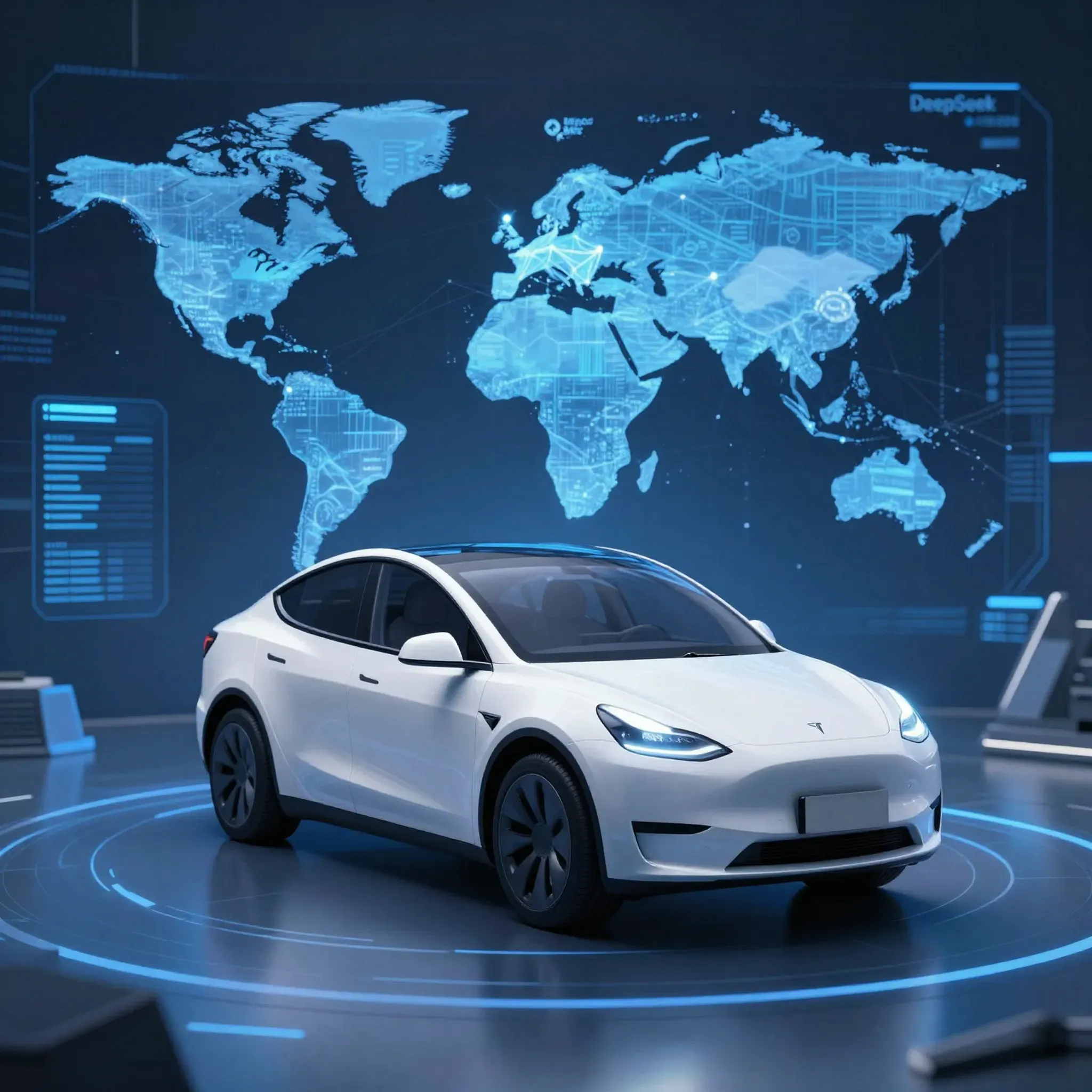
Tesla's decision to integrate AI models from ByteDance and DeepSeek into its in-car voice assistant is a direct response to that reality. It's not a feature update, it's a strategic signal. Even a company as vertically integrated as Tesla is acknowledging that winning in China requires a fundamentally different approach.
For business leaders watching this, the Tesla story is really a proxy for something much larger. Products are becoming platforms. And platforms, increasingly, need to be local.
Why Tesla Is Rethinking Its AI Strategy for China
Tesla is upgrading its in-car voice assistant in China by bringing in locally developed large language models from ByteDance and DeepSeek. The practical improvements are tangible better Mandarin processing, more conversational responses, smoother execution across navigation, media, and vehicle controls.
But the strategic shift underneath is what deserves attention. Tesla built its reputation on owning the full stack. Bringing in external, locally developed AI is a meaningful departure from that model, one driven by three very real pressures. Regulation comes first. China's data localization and AI governance frameworks make foreign AI systems difficult to deploy at scale. Local partnerships aren't a preference here, they're a requirement.
Then there's consumer behavior. Chinese users interact with technology through some of the most sophisticated digital ecosystems in the world. Platforms like Douyin have set an extremely high bar for what intuitive, responsive interfaces feel like. People bring those expectations into the car.
And finally, competition. Nio, Xpeng, and Li Auto have built smart cockpit experiences that Chinese consumers genuinely value. A globally standardized voice assistant, however well-engineered, doesn't compete on that playing field.
Put those three forces together and the conclusion becomes clear: in China's EV market, AI capability is no longer a differentiator. It's a baseline requirement.
How This Shift Changes the EV Business Model
The implications here reach well beyond Tesla's China strategy.
The in-car voice interface is fast becoming the primary way people interact with their vehicles. That shifts where value is created away from pure engineering performance and toward how naturally the system responds to real human behavior. For automotive companies, that's a significant change in what they need to excel at.
It also puts pressure on a model that global companies have relied on for decades. Deploying a single uniform product across markets used to be how you scaled efficiently. That model is under strain now. Markets like China don't just want localized content; they want systems built around local behavior, local regulation, and local digital ecosystems. That increasingly means working with local technology partners rather than building everything internally.
The competitive picture has shifted, too. Chinese EV manufacturers have deliberately made intelligent user experience their primary differentiator. Tesla's move helps close that gap, but it also confirms that the battleground now includes digital experience and ecosystem integration, not just manufacturing quality or battery range.
There's a longer-term revenue angle worth considering as well. Integrating with ByteDance's ecosystem doesn't just improve the assistant; it opens potential pathways into content, services, and in-car engagement. A well-integrated voice assistant becomes an entry point for entertainment, recommendations, and eventually commerce. Industry projections from McKinsey and Deloitte point to software-driven services becoming a significant share of automotive revenue over the next decade. The vehicle is quietly transitioning from a one-time transaction into a recurring engagement platform.
The Rise of AI-Led Vehicle Ecosystems
What Tesla is doing in China fits a pattern appearing across industries.
Financial services have been through a version of this, shifting from fragmented, rules-based systems toward integrated AI-led architectures built for real-time decisions. Automotive is entering a similar phase now.
Navigation, entertainment, and vehicle controls used to be separate systems. They're being unified under a single intelligence layer that learns from behavior, adapts to context, and improves over time. That changes competition in a fundamental way. The advantage no longer comes from building a better product once. It comes from building a system that keeps evolving and can do so differently depending on where and how it's being used.
That's where localized AI partnerships stop being a workaround and start becoming a genuine strategic asset.
Conclusion
Tesla's integration of ByteDance and DeepSeek isn't a story about one company updating a feature. It's an early signal of where the entire industry is heading toward vehicles where intelligence, not just engineering, defines value and competitive position.
The winners won't always be the most technically advanced. They'll be the ones who make their technology feel like it was genuinely built for the person using it, in the market where they're using it.
At JMC, we track how industries evolve at the intersection of technology and business strategy, helping decision-makers understand where the next competitive edge is being built.
Is your organization building products for global scale or designing intelligence that can actually win in local markets?