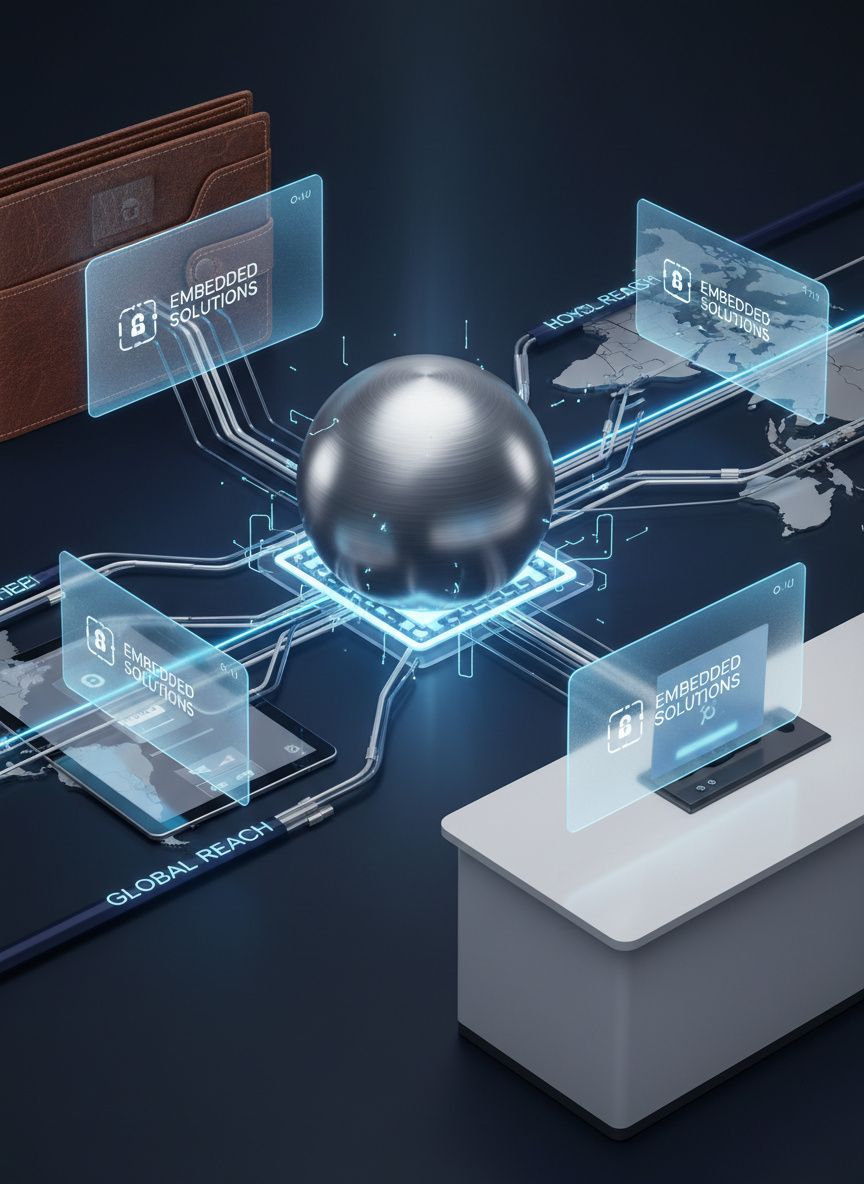
The financial industry is evolving rapidly for enterprises. Embedded payment solutions + global payment systems + fintech integration together reshape customer journeys and margins. The opportunities are significant in this field, and the advancement is what will help businesses grow today. According to JMC, embedded, global and fintech payment solutions are enablers of measurable levels for growth, efficiency and strategic advantage.
What Are Embedded Payment Solutions?
An embedded payment solution refers to the effortless integration of payment directly into non-financial platforms. In simple language, it allows users to make payments directly to the enterprise without being redirected to external gateways. For example, how Uber allows payment in-app and how Amazon completes a purchase with no redirects. The checkout is seamless, secure, near-instant—reducing friction and drop-offs. Secure-by-design (tokenization, SCA) keeps checkout native without compromising compliance.
This technology is growing and is being integrated into each system. Research suggests that embedded finance will rise up to $7 trillion by 2030 (Verified Market Reports). The trend is increasing in demand as consumers want the payment process to be part of their journey and not in between apps.
How is it beneficial?
Embedded payment technology brings about various advantages to the enterprises:
- Retention/NPS: Transactions are much more smoother and effortless, which makes for higher satisfaction and repeat engagement.Satisfied customers tend to stay longer and buy more often, boosting LTV and reducing CAC over time.
- Revenue Growth: Lesser redirects reduce cart abandonment and increase in conversion. Small rise in conversion directly drives up revenues and lowers spend per paying customers.
- Data personalization: First-party payment data enables personalized credit. Hyper-targeted upsells and cross-sells increase the average order value and expand margins without proportional marketing spend.
- Cost Efficiency: Cut third-party fees & operations overhead. Lower payment processing and operational costs flow directly through to EBITDA margins.
Shopify’s embedded payments within its platform, enabling merchants to sell faster by tracking revenue and avoiding the involvement of third parties. Native payment methods have shortened cash flow time and simplified reconciliation.
Integration of Embedded UPI in Business
India’s Unified Payment Interface is a digital benchmark in transaction history. Its integration into embedded solutions has given businesses a new face and innovative models. Embedded UPI works across multiple modes like in-app UPI intent flows, QR-based payments in-store, and one-tap checkout in digital journeys covering online and offline use cases.
For example, Swiggy and Zomato use UPI for their transactions, making checkout as simple as one tap. UPI showcases how local rails at national scale can plug into global merchant flows, think ‘pay local, scale global. Similarly, small retail shops in India today are using QR-based embedded UPI, reducing dependency on external web checkout and POS hardware.
The business impact is significant, faster settlement improves cash flow, and its low-cost infrastructure drives higher acceptance among long-tail merchants. This benefits businesses with improved liquidity, better engagement for users through frictionless low-cost transactions, and increased trust in the digital ecosystem.
As a result, businesses today are actively considering fintech payment integration and embedded UPI to adopt user-first solutions to increase trust in digital ecosystems.
How Embedded Technology Delivers Long-Term Value to Banks
Creating a payment hub for consolidated payment infrastructure is benefiting banks and making operations easier, where all payment systems (cards, wires, UPI) can be integrated into one single payment architecture.
Embedded finance is booming. The global embedded finance market is estimated at nearly $83 billion in 2023 and projected to reach $588 billion by 2030. (Grand View Research)
Why Banks Are Centralizing on Payment Hubs:
- Efficiency: Shared services for routing
- sanction screening
- exceptions.
- Scalability:Plug-and-play for new rails (RTP,FedNow,SEPA Instant,UPI,Pix).
- Risk Management: It improves compliance and fraud detection through a Unified monitoring system (AML
- fraud
- ISO 20022 data).
- Insight: Cross-rail analytics for liquidity & product innovation.
Global Banks are adopting payment hubs to strategize their reporting time, reducing errors and improving regulatory adherence. For instance, HSBC has publicly shared its move towards a centralized payment hub to simplify operations across multiple markets and improve compliance, a model followed by many global players.
What is Global Payment Solutions?
A Global Payment solution enables businesses to send, receive payments across the globe in multiple countries with different currencies. Global also includes local payment methods (LPMs) like SEPA, iDEAL, Boleto, Pix, UPI, and others that adhere with local regulations. Unlike domestic banks with embedded systems, they focus on making international trade effortless.
Leaders like Paypal, Stripe, and Wise provide enterprises to pay like a local, settle like a global, offering regional acceptance while centralizing FX conversion, faster payouts, and automated reconciliation. This treasury lens is critical for optimizing liquidity, reducing FX costs, and maintaining compliance across various levels of jurisdiction.
Benefits of Global Payment
- Market Expansion: Businesses can now enter new markets without building full banking stacks, reducing time and CapEx risk.
- Multiple Currency Handling: Prices that settle in more than 100 currencies, reduce FX leakage with smart routing to protect margins and optimize treasury operations.
- Regulatory Alignment: Built-in KYC/AML and data-residency controls regulate compliance risk and reduce potential penalties.
- Customer Trust: Localized payment methods increase conversion rate, thus lowering fraud exposure and enhancing the LTV.
- B2B platform enablement: Supports cross-border invoicing and payouts for platforms and marketplaces, driving faster settlement cycles.
Netflix, for example, supports domestic payment methods (UPI in India, SEPA transactions in Europe) while keeping a consistent subscription which complies with local payment regulations. This mix of localized payment acceptance and unified global policies ensures customers to pay through familiar methods while business benefits from efficient operations globally.
Future Trends in Global Solutions
- AI-Driven Risk and Control Hub: Real-time fraud analysis, smart routing, and network tokenization lowers the false declines and improves authorization rates.
- CBDCs & Tokenized Assets: Central banks and PSPs are piloting tokenized cross-border settlement, regulatory frameworks drive pace and design.
- Global-Loyal Convergence: Orchestration layers unify global PSPs with local rails under one policy and observability stack.
How Fintech Payment, Global, and Embedded Solutions are Changing the Finance Industry
Payments are no longer a back office function-they’re compliance safeguard, and a scale enabler. Fintech, embedded, and global solutions are transforming payments into strategic drivers of customer loyalty, revenue and operational resilience.
Unify payment methods, enable local rails, and invest in ongoing learning and compliance to future proof payments as a competitive advantage.
At JMC, we believe that embedding payments and tracking real KPIs transform finance from cost centre to growth centre.